
If you are self employed, you can do an IVA to solve your debt problem. An IVA will help you write off your business as well as personal debts. You can include money you owe to HMRC.
Use this guide to get all the information you need about starting a self employed IVA. Find out how to calculate your monthly payments and what happens to your business bank account.
Contents
As a self employed person can you start an IVA?
Yes. As a self employed person, you can solve your debt problem with an IVA.
In fact, it could be an ideal solution for you. This is because you can use it for both your business and personal debts.
Your business loans (including a bounce back loan), business credit card and any money you owe to suppliers can all be included. You can also include outstanding tax owed to HMRC.
Self employed trading history
Before you can start your IVA, you will normally have to have been trading for at least 6 months. This is to make sure that you can sustain your self employed income. You need to have some trading history to prove that you will be able to maintain your agreed monthly payments.
Some IVA companies might say you can’t start an IVA. This will normally be simply because they can’t provide the service.
Setting up and managing a self employed IVA requires expertise which many IVA companies don’t have.
Want to start a self employed IVA? We provide a specialist service for self employed people. Get in touch today to start the process.
How do you calculate your IVA payment if you are self employed?
When you are self employed, calculating what you can afford to pay into your IVA each month is not straight forward.
The reason for this is that you will need to predict what your personal income will be from your business every month. But your business earnings will usually go up and down.
So how do you decide what income figure to use?
The answer is you have to use an average. You can work out your average income in the following way:
- First, take the average amount you have been able to draw from your business each month for the past 6 months (after taking into account business costs).
- Second, make a deduction for tax which you will have to pay on your drawings
- Third, add the amount you are left with to your personal income and expenses budget.
Your monthly IVA payment is based on your personal disposable income. This is the amount you are left with after you have deducted your total personal expenses budget from your personal income.
As a self employed person, you will need specialist help to work out your monthly IVA payment. Speak to one of our experienced self employed IVA experts today to get started.

Can your IVA payment go up?
It is important to understand that your IVA payment can go up. The agreed amount is likely to increase if your financial circumstances improve.
Your self employed business might start to do better during the Arrangement (which is likely to last 5-6 years). If this happens and you earn more money, you will have to pay more.
Your IVA company will carry out a review of your circumstances each year to establish if there have been any changes. As a self employed person, you will have to provide a record of your trading figures for the past 12 months.
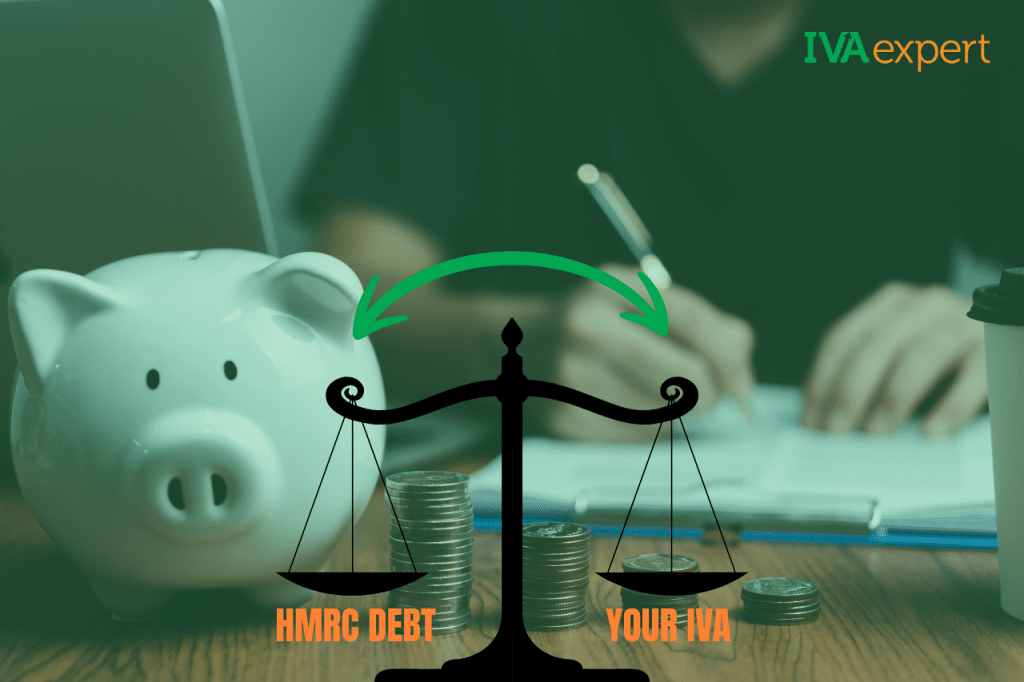
Do you include your HMRC debt in a self employed IVA?
One of the advantages of an IVA over other solutions such as a debt management plan is that you can include money you owe to HMRC.
The main types of debt you might owe to HMRC are:
- Self assessment tax arrears
- VAT arrears
- PAYE arrears
You can include all of these in your IVA agreement.
As a self employed person, before you can start an IVA you will need to make sure that you submit all of your tax returns. This includes your return for the most recent tax year even if it is not yet officially due.
There are two key reasons for this:
Number 1 – HMRC are likely to reject your proposal if you have tax returns outstanding.
Number 2 – You need to know what (if anything) you owe to HMRC for the most recent tax year. You can then include this debt in the Arrangement.
Can you write off a bounce back loan with an IVA?
If you are self employed and you took a Covid bounce back loan, you are personally liable to repay it.
The good news is that you can treat this debt in exactly the same way as any other loan or credit card you have. You include it in your IVA and write it off with the rest.
One of the major advantages of an IVA is that you do not have to give a detailed explanation of what you used your bounce back loan for. If you used some or all of the money in a personal capacity rather than for your self employed business, it does not matter.
This is in stark contrast to what happens if you go bankrupt.
In bankruptcy, the Official Receiver looks carefully at your bounce back loan including how much you borrowed (in relation to your previous year’s turnover) and what you spent the money on. If the money was not used for your business, then in extreme cases, it can lead to accusations of fraud.
If your bounce back loan was higher than it should have been. Or, you used the money for non business purposes, an IVA could be a better option for you than going bankrupt.
What happens to your business bank account in an IVA
You may be able to continue using the same bank account to run your self employed business after you start an IVA. However, this will depend on whether you owe the bank money.
If you do intend to include debt that you owe the bank, you will normally have to stop using your account.
The reason for this is to protect your future business revenue from the banking Set Off rule.
Under this rule, if your bank is owed money it can take any funds you deposit in your current account to set off against the debt you owe. The only way you can guarantee this will not happen is to start using a new account.
There are a number of banks who will open a business account for you even if your credit rating is poor. These include:
- Monzo
- Starling
- Tide
That said, if you are struggling to use open a business bank account, you could open a new personal account and use this – at least as a temporary measure.
You should make sure your new business account is operational before you start your IVA.
Speak to us today to get assistance with implementing a self employed IVA including opening your new business account.
 Written by James Falla
Share this post






Completely FREE advice
Confidential conversations
Expert help always at hand
What we can do
Start an IVA
- In depth advice and guidance
- Comprehensive income and expenses review
- Support through the process

Self Employed IVA
- Business revenue and expenses forecast
- Personal income and expenses review
- Support through the process
Cancel IVA and go Bankrupt
- Help with cancelling IVA
- Support with bankruptcy application
- Ongoing 12 month assistance
Mortgage after an IVA
- Guidance and information
- Planning for a mortgage
- Advice on timing and deposit